

02ChallengesDone
Initial Challenge
Who has the ball? Every frame of a full match labelled home possession, away possession or dead ball, from automatic tracking and tactical tags, with no training on the match.
- 199,319frames labelled H / A / D
- < 10 sfull match on a laptop CPU
- 0hand labels, anywhere
- 15behaviour tests
AIn motion
The idea, animated
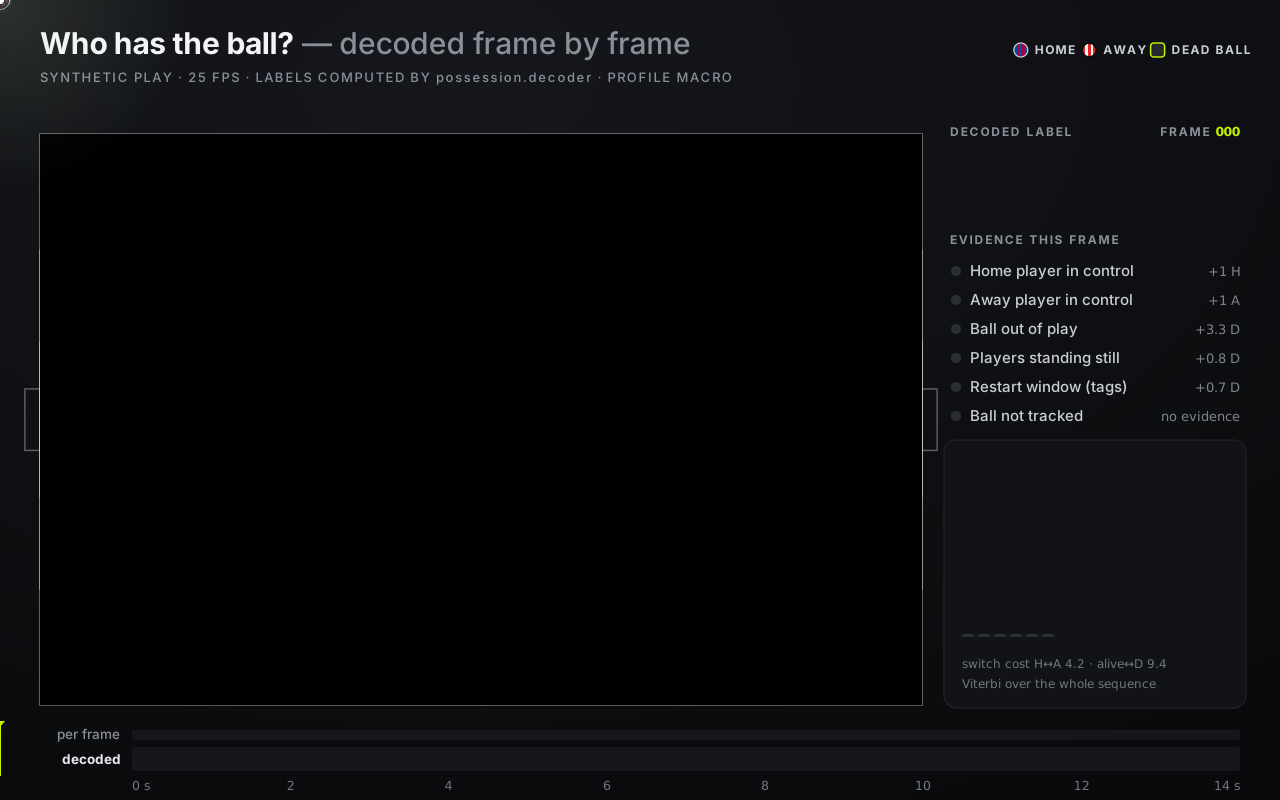
/assets/hero/hero.svgBWhat was asked
One label per frame
For each of the 199,319 frames of one match's tactical video, say who has the ball. Two official metrics grade the answer: spellF1, the ranking metric, scores whole possessions; macroF1 scores every frame.
Possession is control, and control persists: a pass in flight belongs to the passer, and a touch is not a turnover. Every label depends on the frames around it.
The catch: the ball is untracked on 41% of graded frames, so a missing ball has to count as no evidence, not as a stoppage.
- HHome team in possession
- AAway team in possession
- DBall dead
CHow we read the problem
How we read the game
12 reads in four legs, from the question to the proof.
Leg 1
The problem
What is being asked
Leg 2
The scoring
How the answer is judged
Leg 3
The data
What the files can say
- One clock that counts. What each data asset contributes
- Slots are not players. Tactical tracking: the master clock
- No ball, no evidence. The ball goes missing where possession is decided
- Context, not events. Tags are context, not events
- Pixels to pitch. Homography: the bridge between pixels and pitch
- Two cameras, two clocks. Two cameras, two clocks
Leg 4
The rules
What is allowed, and proven
DMethod
Three moves, no training
-
Evidence
Per frame: a player within 1.5 m of the ball and closer than any opponent, ball out of play, collective stillness, restart windows from Smart Tagging, and calibrated team signals from every tag code.
-
Decode
An exact Viterbi pass per half over three states (H, A, D), with a cost for every change of state. One noisy frame cannot flip possession; a reception and a touch can.
-
Choose
Parameters come from a Pareto front of spellF1 and macroF1 on simulated matches with known answers. The submitted profile was picked on a real, externally labelled Bundesliga match.
EExternal validation
Tested on labels we did not make
| Method | spellF1clean | macroF1clean | spellF1degraded | macroF1degraded | Possessionsdegraded, truth 402 |
|---|---|---|---|---|---|
| Organiser baseline method (smooth50) | 0.301 | 0.385 | 0.235 | 0.383 | 570 |
| Ours, hand-reasoned | 0.442 | 0.835 | 0.249 | 0.661 | 166 |
| Ours, balanced | 0.448 | 0.855 | 0.286 | 0.686 | 186 |
| Ours, macro (submitted) | 0.482 | 0.856 | 0.340 | 0.693 | 249 |
Open DFL/IDSSE data (Bassek et al. 2025, CC-BY 4.0), scored with the official, unchanged metric. There is no Smart Tagging for DFL, so this measures the tracking part of the pipeline.
Read the last column too. The baseline method reports 570 possessions where the match has 402: it invents turnovers. We report 249: turnovers hidden in long tracking gaps arrive late, and that gap is what the roadmap goes after.
FGo deeper
Code and report
Reproduce the submission with Docker in under ten seconds, read the full reasoning, trials and limitations in the technical report, or walk the design call by call in the architecture study.